This document has been compiled using indicators provided by the Market-Signals trading bot which studies global market data. This document shows the evolution of the strategies proposed by the bot and gives the trends of a selection of ETFs, which follow the main world markets, for December 2025. The strategies hold only long positions. No leverage is used. This document is for information purposes only and should not be taken as investment advice.
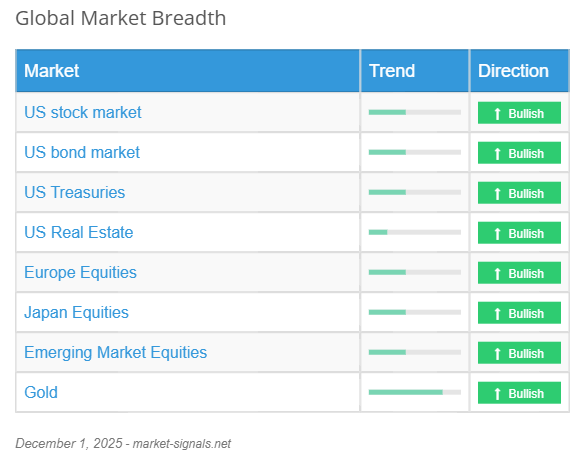
Global Market Breadth
| Market | Trend | Direction |
|---|---|---|
| US stock market |
|
|
| US bond market |
|
|
| US Treasuries |
|
|
| US Real Estate |
|
|
| Europe Equities |
|
|
| Japan Equities |
|
|
| Emerging Market Equities |
|
|
| Gold |
|
Portfolios
US Growth Portfolio
T
he portfolio US Growth dropped 1.56% in November. We find a positive trend in the U.S. stock market, we assume a Risk-On market regime and the portfolio is allocated to a U.S. equity ETF. The asset allocation remains the same this month. The ETF selected in the portfolio for this month is QQQ (100%). The portfolio trend for December is bullish with a Trend Score in regression of 6 out of 10. The degree of risk of the strategy for December is medium with a Risk Score unchanged of 4 out of 10.
The 1-year performance of this strategy is 6.04%. Since opening the portfolio at eToro in November 2019, the strategy has performed 162.04%, in comparison, the benchmark asset (S&P 500) has advanced 146.18%. The strategy has suffered a maximum loss of 19.95% since the portfolio opened at eToro, compared to the benchmark asset (S&P 500) which lost 23.91% at maximum.
This strategy captures the U.S. stock market growth for long-term investors who want high returns.
Since inception at eToro
Max drawdown
Since inception at eToro
Portfolio: -19.95%
S&P 500: -23.91%
- eToro portfolio
US Balanced Portfolio
T
he portfolio US Balanced dropped 0.96% last month. The strategy combines an allocation in US bonds (30%) with the US Growth portfolio (70%). The trend in the US bond market for December is positive. The bond part contains the following 2 ETFs: LQD and BND. Asset allocation does not change in December. The portfolio contains the following 3 ETFs: QQQ (70%), LQD (15%) and BND (15%). The portfolio trend for December is positive with a Trend Score in decline of 5 out of 10. The degree of risk of the strategy for this month is low with a Risk Score constant of 3 out of 10.
The 1-year trailing return of this portfolio is 2.19%.
This strategy provides a balanced stocks and bonds allocation for investors who want a U.S. market exposure with limited risks.
Global Conservative Portfolio
T
he portfolio Global Conservative receded 0.07% in November. The Strategy combines a multi-market protective asset allocation strategy (Global Stable portfolio 70%) and a US stock market strategy (US Growth portfolio 30%). The portfolio contains the following 6 Trackers: QQQ (41%), GLD (11%), EEM (11%), EWJ (11%), EFA (11%) and SPY (11%). The portfolio trend for this month is positive with a Trend Score in decline of 5 out of 10. The degree of risk of the strategy for December is medium with a Risk Score stable of 4 out of 10.
The 1-year trailing return of this strategy is 5.46%.
This strategy provides a broad geographic diversification for investors who want an international exposure.
Global Stable Portfolio
T
he portfolio Global Stable continued to gain ground by 0.62% in November. The overall market trend for December is strongly positive. By analyzing a diverse multi-market composed of 12 Exchange Traded Funds (stocks, bonds, gold, real estate, international and emerging markets...), we observe that 12 assets show a positive evolution. Our model allocates 100% to Risk-On assets and 0% to Risk-Off assets. The 6 Exchange Traded Funds of the portfolio for this month are GLD (16%), EEM (16%), QQQ (16%), EWJ (16%), EFA (16%) and SPY (16%). The portfolio trend for December is positive with a Trend Score in decline of 5 out of 10. The level of risk of the strategy for December is medium with a Risk Score constant of 4 out of 10.
The 1-year trailing return of this portfolio is 8%.
This is the safest strategy, the one with the lowest volatility and the least max drawdown of the 4 offered, that makes this strategy an alternative to a 1-Year Term Deposit.
ETF Trends

GLD SPDR Gold
- Gold
The GLD ETF, which monitors the performance of gold, continues its strong increase of 5.37% last month. The evolution of the performance of this Exchange-Traded Fund over 1 year is 57.96%. The trend in December is measurably bullish with a Trend Score unchanged of 8 out of 10. The degree of risk of this Exchange-Traded Fund in December is medium with a Risk Score in regression of 4 out of 10. This ETF is present in the portfolios Global Stable and Global Conservative this month.

QQQ Invesco QQQ
- Nasdaq 100
The QQQ ETF, which measures 100 largest US companies in the non-financial sector, fell 1.56% in November. The performance over a period of 1 year of this equity is 21.61%. The trend in this month is bullish with a Trend Score in regression of 6 out of 10. The degree of risk of this equity in December is medium with a Risk Score stable of 4 out of 10. This ETF is present in the strategies US Growth, Global Stable, Global Conservative and US Balanced in December.

BND Vanguard Total Bond Market ETF
- US Total Bond Market
The BND Exchange-Traded Fund, which follows intermediate-term bonds being traded in the United States, retreated 0.05% in November. The evolution of the performance of this ETF over 1 year is 1.37%. The trend in December is bullish with a Trend Score in growth of 4 out of 10. The degree of risk of this ETF in December is low with a Risk Score in decline of 1 out of 10. This equity is invested in the strategy US Balanced in December.

TLT iShares 20+ Year Treasury Bond ETF
- Long-Term US Treasuries
The TLT ETF, which mimics the long-term sector of the U.S. Treasury market, dropped 0.09% last month. The evolution of the performance of this ETF over 1 year is -3.23%. The trend in December is positive with a Trend Score in progression of 4 out of 10. The level of risk of this ETF in December is low with a Risk Score in regression of 2 out of 10.

VGK Vanguard FTSE Europe ETF
- Europe Equities
The VGK ETF, which mimics European Equities, continued to grow by 1.53% last month. The 1 year trailing return of this equity is 22.73%. The trend in this month is bullish with a Trend Score steady of 4 out of 10. The level of risk of this equity in December is low with a Risk Score steady of 3 out of 10.

SPY SPDR S&P 500 ETF
- S&P 500
The SPY ETF, which measures a basket of large-cap U.S. stocks, continued to grow by 0.19% in November. The performance over a period of 1 year of this ETF is 13.46%. The trend in December is positive with a Trend Score in regression of 4 out of 10. The level of risk of this ETF in December is low with a Risk Score steady of 3 out of 10. This ETF is present in the strategies Global Stable and Global Conservative this month.

EWJ iShares MSCI JAPAN ETF
- Japan Equities
The EWJ ETF, which replicates large and mid cap segments of the Japanese market, fell 0.53% in November. The performance over a period of 1 year of this equity is 20.29%. The trend in December is bullish with a Trend Score in decline of 4 out of 10. The level of risk of this equity in December is medium with a Risk Score stable of 4 out of 10. This ETF is invested in the strategies Global Stable and Global Conservative in December.

IWM iShares Russell 2000 ETF
- US Small Cap Equities
The IWM Exchange-Traded Fund from iShares, which monitors small public U.S. companies, continued to gain ground by 1.02% last month. The performance over a period of 1 year of this equity is 2.90%. The trend in December is bullish with a Trend Score in decline of 4 out of 10. The degree of risk of this equity in this month is medium with a Risk Score in rise of 4 out of 10.

EEM iShares MSCI Emerging Markets ETF
- Emerging Market Equities
The EEM ETF from iShares, which tracks the MSCI Emerging Markets Index, retreated 1.77% in November. The performance over a period of 1 year of this Exchange-Traded Fund is 25.58%. The trend in December is positive with a Trend Score in decline of 4 out of 10. The level of risk of this Exchange-Traded Fund in this month is low with a Risk Score in decline of 3 out of 10. This Exchange-Traded Fund is invested in the portfolios Global Stable and Global Conservative in December.

IEF iShares 7-10 Year Treasury Bond ETF
- Intermediate-term US Treasuries
The IEF ETF from iShares, which mimics intermediate-term U.S. Treasury bonds, continued to gain ground by 0.67% in November. The performance over a period of 1 year of this equity is 2.11%. The trend in December is lightly bullish with a Trend Score unchanged of 3 out of 10. The level of risk of this equity in December is low with a Risk Score unchanged of 1 out of 10.

MDY SPDR S&P Midcap 400
- Midcap 400
The MDY ETF from SPDR, which measures the S&P MidCap 400 Index, bounced back 2.11% in November. The performance over a period of 1 year of this Exchange-Traded Fund is -1.63%. The trend in December is weakly bullish with a Trend Score constant of 3 out of 10. The degree of risk of this Exchange-Traded Fund in December is medium with a Risk Score in progression of 4 out of 10.

LQD iShares iBoxx $ Investment Grade Corporate Bond
- US Corporate Bonds
The LQD ETF, which measures U.S. investment grade corporate bonds, shifted upwards 0.19% last month. The 1 year trailing return of this ETF is 0.91%. The trend in December is lightly positive with a Trend Score stable of 3 out of 10. The level of risk of this ETF in December is low with a Risk Score stable of 1 out of 10. This equity is invested in the portfolio US Balanced this month.

EFA iShares MSCI EAFE ETF
- Europe, Australia and Far East Equities
The EFA ETF, which tracks markets in Europe, Australia and the Far East, continued to grow by 0.74% in November. The evolution of the performance of this equity over 1 year is 21.79%. The trend in December is weakly bullish with a Trend Score in decline of 3 out of 10. The level of risk of this equity in December is medium with a Risk Score in rise of 4 out of 10. This equity is invested in the portfolios Global Stable and Global Conservative in December.

VNQ Vanguard Real Estate ETF
- US Real Estate
The VNQ Exchange-Traded Fund, which tracks REITs and other real estate-related investments, bounced back 2.42% in November. The 1 year trailing return of this equity is -7.14%. The trend in December is lightly positive with a Trend Score constant of 2 out of 10. The degree of risk of this equity in December is low with a Risk Score constant of 3 out of 10.

JNK SPDR Bloomberg High Yield Bond
- High Yield Bonds
The JNK ETF, which replicates US high-yield corporate bonds, shifted upwards 0.27% last month. The evolution of the performance of this equity over 1 year is 0%. The trend in December is weakly bullish with a Trend Score stable of 2 out of 10. The level of risk of this equity in December is low with a Risk Score stable of 1 out of 10.
Compliance disclaimer
This communication is for information and education purposes only and should not be taken as investment advice, a personal recommendation,
or an offer of, or solicitation to buy or sell, any financial instruments.
Natevia makes no representation and assumes no liability as to the accuracy or completeness of the content of this publication,
which has been prepared utilizing publicly-available information.
Past Performance is not indicative of future results.